

THE DEATH OF THE TRADITIONAL HOUSING MODEL
The house we grew up expecting may not be the house the next generation wants.
The future of housing is changing,
For decades, the formula was simple.
Buy a house. Get a mortgage. Fill it with stuff. Work somewhere else. Drive everywhere.
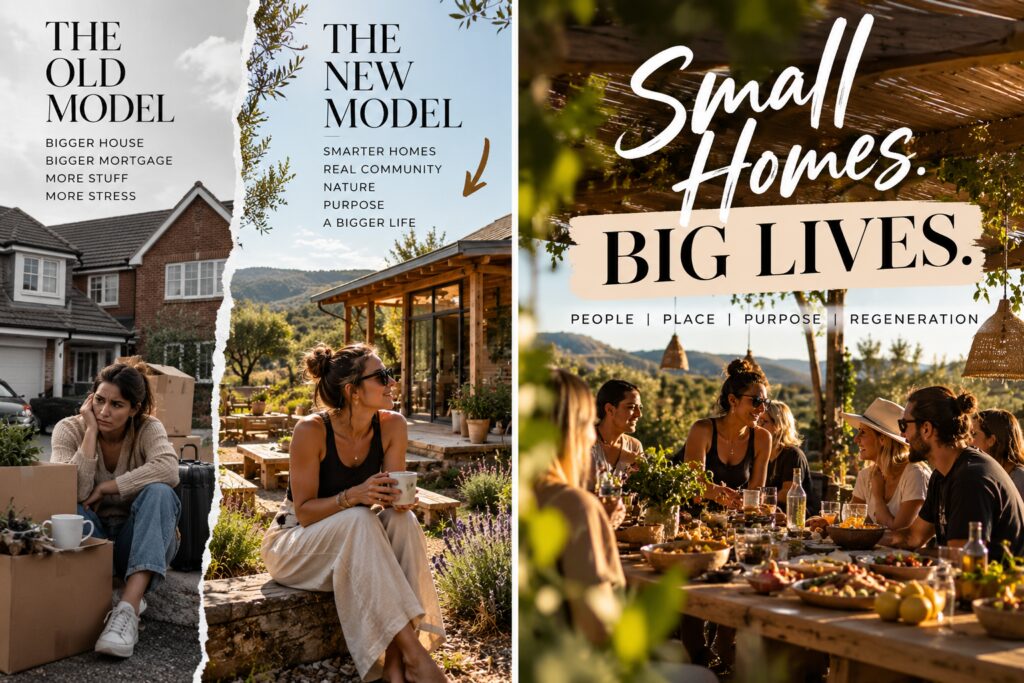
WE DON’T JUST NEED MORE HOMES. WE NEED DIFFERENT ONES.
Spain is already feeling the pressure as the future of housing is changing.
CBRE identifies a growing mismatch between housing supply and demand, with strong demand for smaller and more flexible living options. Spain also has a significant structural housing deficit.
So perhaps the question isn’t:
How do we build more houses?
It’s:
How should we be living?
That’s where sustainable co-living, smaller homes and alternative housing models become interesting.
Not because everyone suddenly wants to share a kitchen.
But because private space and shared space can work differently.
A smaller private home can sit within a much bigger ecosystem:
Workspaces.
Gardens.
Wellbeing.
Food growing.
Creative spaces.
Community facilities.
Nature.
Small private space. Big shared life.
CO-LIVING NEEDS TO BE MORE THAN ACCOMMODATION
This is where I think the sector has enormous potential because future of housing is changing.
The best communities won’t simply put people next to each other.
They’ll give people reasons to participate.
A chef can cook.
A gardener can grow.
An entrepreneur can build.
A maker can teach.
A remote worker can bring skills and international connections.
Suddenly, community isn’t an amenity.
Community becomes infrastructure.
And that changes the value proposition completely.
THE NEXT STEP IS REGENERATION
Sustainability asks:
How do we reduce our impact?
Regeneration asks:
How do we leave something better behind?
That’s the shift I’m interested in.
Land.
Buildings.
Food.
Water.
Energy.
People.
All working together rather than existing as separate pieces.
And no, regenerative living doesn’t have to mean roughing it.
Modern comfort and greater self-reliance can absolutely coexist.
WHY I THINK THIS MATTERS
My background is commercial.
I look at ideas and ask:
Who needs this?
Why will they choose it?
How does it work financially?
And can it actually work in the real world?
That’s the lens I’m bringing to regenerative living.
Because I don’t want to create another pretty eco project.
I want to explore whether we can build a better model for living, as I identify that the future of housing is changing, one that is commercially viable, environmentally intelligent and genuinely desirable.
THE FUTURE OF HOUSING IS ALREADY CHANGING
I’m interested in what comes next.