
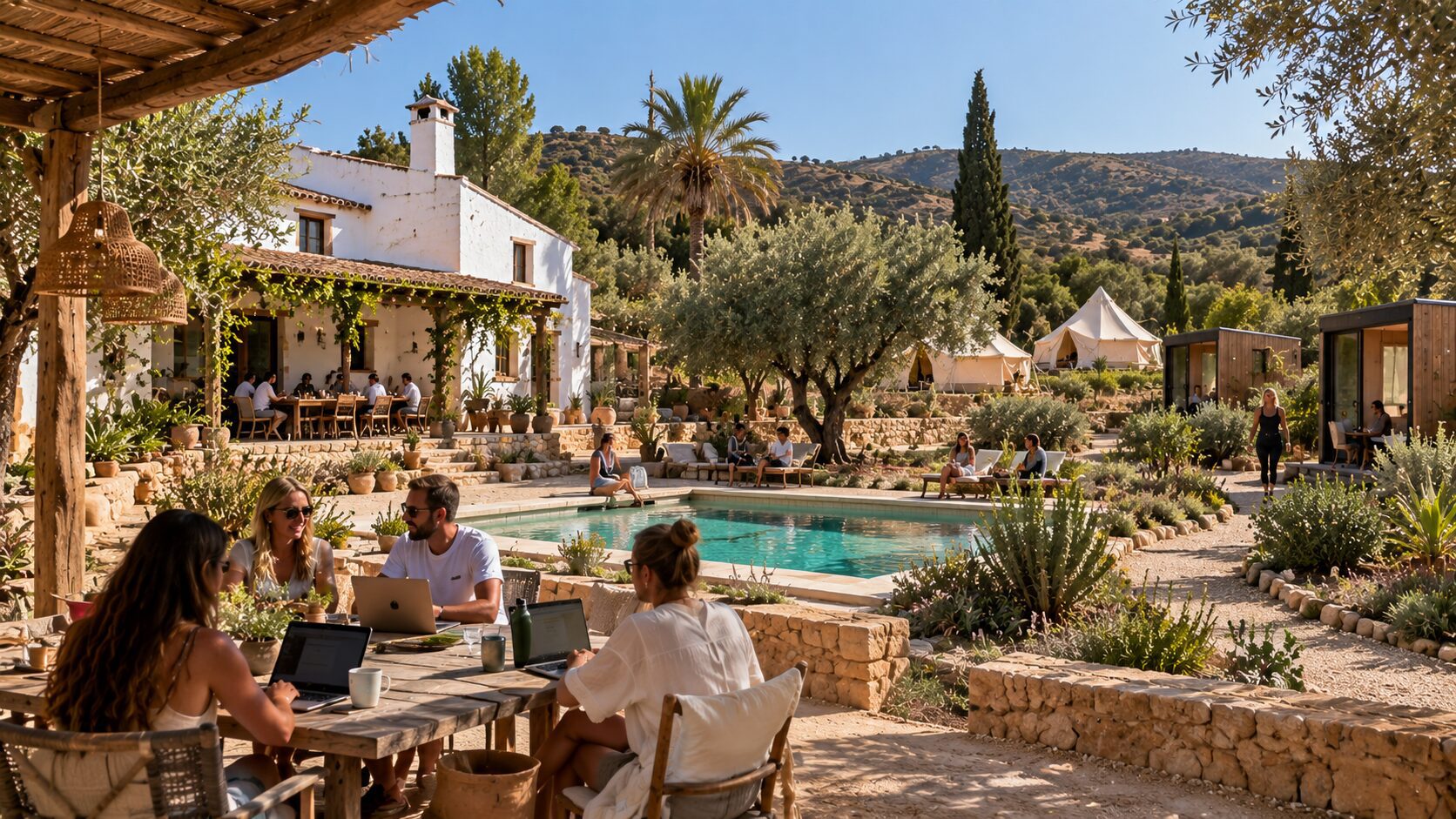
The Future of Living: Regeneration, Community & a Different Way Forward
At Gold Button Collective HQ I’ve become increasingly interested in regeneration, sustainable development and the future of how we live and work.
Not property development in the traditional sense.
Something considerably more interesting.
The opportunity to create places where sustainable living, co-living, entrepreneurship, hospitality, events, wellbeing and community operate as one interconnected ecosystem.
Because I don’t think the next generation of successful developments will simply be collections of beautiful buildings.
They will be living ecosystems.
From Property Development to Regenerative Development
There is an important distinction between development and regeneration.
Development can create something new.
Regeneration should create something that has a positive impact beyond itself.
That means thinking about the economic, environmental and social infrastructure surrounding a place.
How can underused land or buildings be brought back into productive use?
How can a sustainable community generate employment and support local businesses?
How can renewable energy, responsible land management, food production and low-impact infrastructure become part of the operating model rather than simply features added for marketing purposes?
And, crucially, how can the entire model remain commercially viable?
Because sustainability without economic resilience is difficult to sustain.
A genuinely regenerative development needs to create value across multiple dimensions:
environmental value, social value and economic value.
That’s where I find the thinking particularly compelling.
The Evolution of Co-Living
Co-living is often reduced to a simple proposition: private accommodation with shared facilities.
I think the opportunity is much broader.
The most compelling co-living communities could become platforms for participation.
A resident might have their own private accommodation while sharing access to workspace, gardens, communal kitchens, wellness facilities, creative spaces and social areas.
But the real value isn’t the physical infrastructure.
It’s the network created around it.
A chef can contribute to communal dining.
A gardener can contribute to food production.
A wellness practitioner can run classes.
An entrepreneur can host a workshop.
A creative can contribute to events and cultural programming.
A remote worker can bring their business, skills and economic activity into the community.
The result is something very different from a conventional residential development.
It becomes a micro-economy.
The Digital Nomad Community Is Evolving
The digital nomad movement has already demonstrated that work no longer needs to be tied to a traditional office.
But I think the next question is far more interesting.
If you can work from anywhere, where do you actually want to live?
Good Wi-Fi and a desk are no longer enough.
For many remote workers, freelancers, founders and entrepreneurs, the attraction is increasingly about quality of life, connection and belonging.
Imagine working remotely from a beautiful natural environment without becoming isolated.
You have somewhere genuinely inspiring to work.
People around you who are building businesses, creating things and pursuing different careers.
Shared meals.
Events.
Workshops.
Wellbeing.
Outdoor space.
Creative collaboration.
And still, importantly, a private place to retreat to.
That is not simply co-working.
It is co-living supported by a social and economic infrastructure.
And I believe that distinction will become increasingly important as remote work continues to reshape where people choose to live.
Sustainability Needs to Be Designed Into the System
I am particularly interested in sustainable living models that go beyond the aesthetic version of “eco”.
Solar energy is useful.
Natural materials are useful.
Water conservation matters.
Food production matters.
Biodiversity matters.
Responsible land management matters.
But the bigger question is how those elements interact.
Can energy systems reduce operating costs?
Can food production contribute to both sustainability and community?
Can land become productive without becoming intensively exploited?
Can buildings and existing structures be adapted rather than unnecessarily replaced?
Can hospitality, accommodation, events and enterprise create enough economic activity to support the wider model?
That’s where regenerative development becomes much more interesting than simply building an “eco property”.
This thinking aligns with the wider principles of sustainable development.
It’s to create a system that functions sustainably.
Creating Places for People to Participate
I’ve spent much of my career working across sales, commercial strategy, entrepreneurship, leadership and business development.
Increasingly, I’m interested in what happens when those disciplines are applied to physical environments.
Because a place can simply provide accommodation.
Or it can provide infrastructure for human potential.
Infrastructure for entrepreneurs.
For remote workers.
For creatives.
For founders.
For people changing careers.
For people looking for a different way to live.
For facilitators running retreats and workshops.
For businesses looking for somewhere distinctive to bring their teams.
For communities looking for meaningful connection.
That creates a much richer proposition than accommodation alone.
It creates an environment where people, businesses, events, skills and resources circulate through the same ecosystem.
The Future May Be Smaller, More Connected and More Intentional
I don’t think the future of living necessarily means bigger houses, larger developments and greater consumption.
I think there is a growing opportunity for something more intentional.
Less isolation.
More community.
Less passive consumption.
More participation.
Less wasted space.
More productive land.
Less separation between living and working.
More integration.
The opportunity is to create places where people can live, work, learn, create, collaborate and contribute.
Places that are commercially viable.
Environmentally responsible.
Socially connected.
And genuinely useful to the communities around them.
That is the kind of regeneration I’m interested in.
Not another resort.
Not another generic co-working space.
Not another collection of holiday accommodation.
And not co-living for the sake of co-living.
Something more integrated.
A sustainable community and economic ecosystem designed around the way people increasingly want to live and work.
I think we’re only beginning to understand what that could look like.
And that is precisely what makes it interesting.